
For legal professionals using generative AI, nothing is more important than safeguarding sensitive information and maintaining client confidentiality. In fact, lawyers are ethically obligated to refrain from submitting confidential client information to AI models without first taking precautions like anonymizing or redacting it.
However, manually scrubbing sensitive details from every prompt can be tedious, time-consuming, and prone to human error. To help guard against this, Certera features a built-in legal data anonymization tool designed to detect and mask PII, PHI, and private information before your prompts ever reach an AI model.
How to Use the Built In Data Anonymization Tool
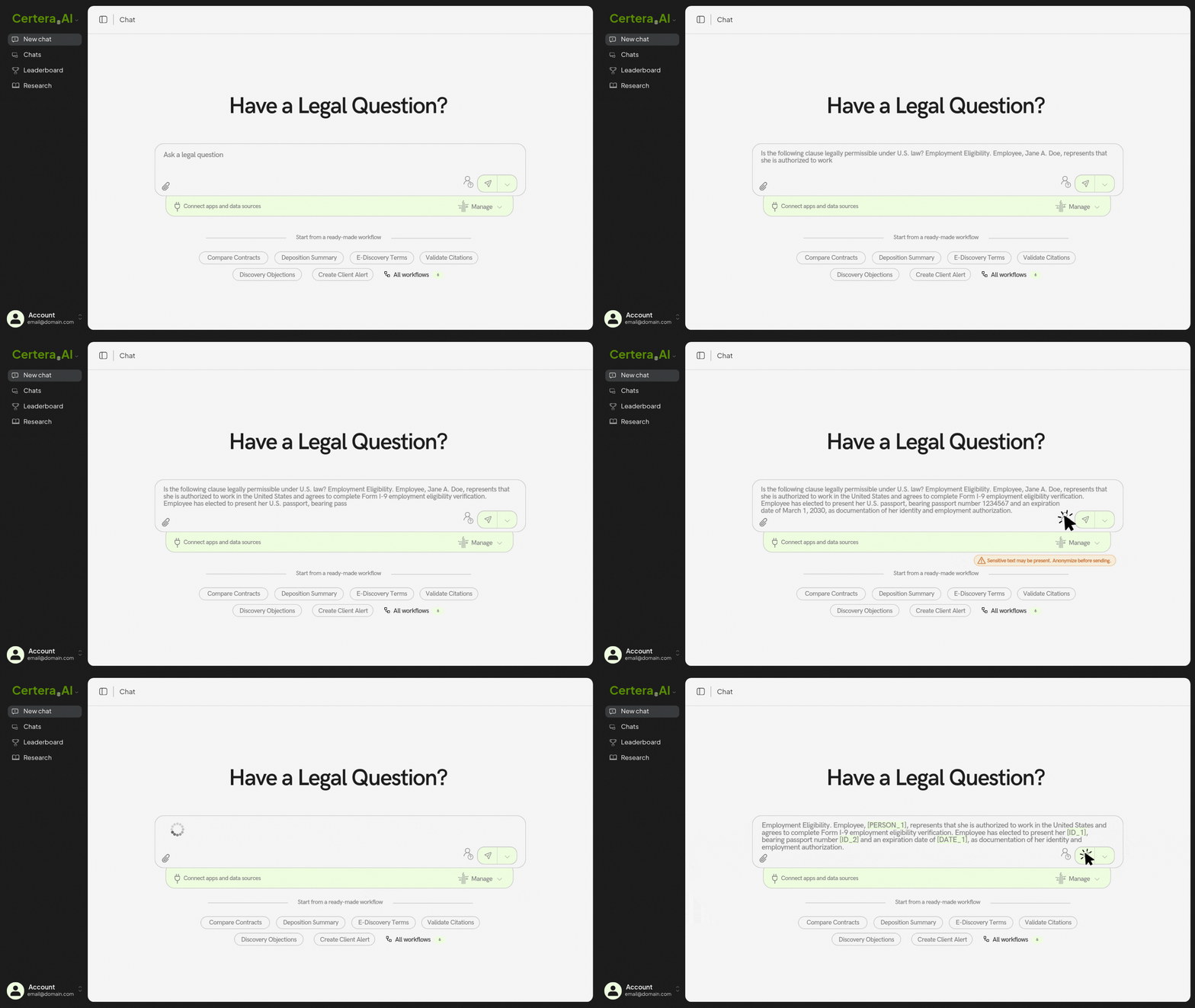
Use of the anonymization tool is straightforward:
- Enter your prompt
- Click the anonymization button
- Review the anonymized prompt
- Remove any remaining sensitive information manually
- Submit
The image below shows the process in action.
What Information Does Certera Anonymize?
When you click the anonymization button, Certera scans your prompt for sensitive information like personally identifiable information (PII) and certain confidential business information. It then replaces each one with a consistent, numbered placeholder.
Before:

After:

Among others, Certera detects and replaces the following categories:
- Names of individuals
- Organizations and Companies
- Email addresses
- Phone numbers
- Addresses
- Dates
- Social Security numbers
- Driver's licenses, case numbers, medical record numbers, and similar identifiers
- Account numbers
- Bank, financial, and other account numbers
- PII
A couple additional things to note about the data anonymization tool:
- Placeholders are consistent. Each unique person, organization, or identifier gets its own numbered placeholder, and that placeholder is reused every time the same entity appears. If "Maria Lopez" becomes [PERSON_1] in your first sentence, she stays [PERSON_1] throughout the prompt — so the AI can still follow who did what, and you can still read the response in context.
- Only sensitive information is changed. The tool only changes sensitive information. Your wording, punctuation, line breaks, and formatting are preserved character for character, so your prompt's meaning and structure remain intact.
No data anonymization tool is perfect, so be sure to double check your revised prompt and remove any private or sensitive information you do not want to send to AI models. Automated detection is pattern and context based, and no tool catches everything. Distinctive facts, a rare medical condition, an unusual job title, a one-of-a-kind event might identify a person even with every name removed. So each anonymized output should be reviewed.
Use Zero Data Retention for Additional Protection
For increased protection, you should use models that offer Zero Data Retention (ZDR). This is an AI model setting that prevents model providers from keeping your data after your request is processed. In a ZDR mode, the provider does not store your prompts or responses, does not use them to train its models, and does not have humans review them. By default, Certera will use an AI model’s ZDR mode when available, but not all models offer ZDR.
To use it, enable it when using random mode or if using custom mode select only models that have the ZDR icon next to them.
Random Mode:

Custom Mode:

Does Certera Save the Pre-Anonymized Prompt?
No. Every step of this process runs with zero data retention, so no provider keeps your original text. Not even Certera. The anonymized version is sent directly back to your input box. We don't write your original text to our database, logs, or analytics. If anonymization fails, your original text returns to the input box on your device.
What About Uploaded Files?
One final note, as of now, the anonymization feature does not scrub any files or documents included with the prompt, however, if sensitive information is detected in uploads, a warning will appear. Regardless, be sure to manually remove any sensitive data you send with your inputs. To do so, you can use legal data anonymization tools like Justee.